Returning to Betting After Self-Exclusion: What Safeguards Matter Most?
1. Before You Return: Are You Actually Ready to Bet Again? The first safeguard isn’t a tool on a betting site – it’s whether you’re genuinely…
What the law actually requires, what it leaves entirely to you, and the handful of steps that decide whether a wedding is a marriage.

Marriage in Australia is governed by one Commonwealth statute, and the legal content of a wedding is remarkably small. An authorised celebrant, a notice given a month ahead, two witnesses, a few compulsory words and a signature turn a ceremony into a marriage. Everything else is yours.
Couples usually arrive at this subject expecting bureaucracy and find something closer to the opposite: a short list of requirements, most of which are administrative, wrapped around a ceremony that the law barely prescribes at all. The difficulty is rarely complexity. It is that the few rules which do exist are unforgiving about timing, and that the most common misunderstandings concern paperwork people only discover afterwards.
Understanding legal requirements and deadlines is equally important in other regulated activities, including online gambling. When exploring a bitcoin casino, users should pay attention to licensing, age restrictions, identity verification, and withdrawal conditions. Just as marriage paperwork requires careful attention to specific rules, cryptocurrency gambling involves legal and financial obligations that vary by jurisdiction and should be understood before participating.
Three things carry nearly all of the legal weight. The person conducting the ceremony must be authorised. The notice must reach that person within a defined window. And certain words must actually be said in the presence of two witnesses. Miss any of those and the ceremony, however beautiful, has not produced a marriage.
Everything else on this page sits around that core: the documents that support the notice, what is signed on the day, how the marriage reaches a government register afterwards, and how to choose the person who will run it.
It is worth stating the negative early, because it saves a great deal of worry. Australian law does not require a particular venue, a religious element, a particular form of dress, a rehearsal, a specific number of guests, a name change, or vows of any particular sentiment beyond one prescribed sentence. There is no residency requirement and no requirement to marry in the state where the notice was given.
Capacity is the one area where the law is genuinely restrictive, and it is worth checking early rather than assuming. Four conditions matter.
| Condition | What it means |
|---|---|
| Age | Both parties must be at least eighteen. A person aged sixteen or seventeen may marry a person aged eighteen or over only with a court order, granted where the circumstances are exceptional and unusual, together with parental consent. Two people under eighteen cannot marry each other. |
| Not already married | A marriage is void if either party is already lawfully married to someone else at the time. A divorce must be finalised, not merely applied for. |
| Not a prohibited relationship | Marriages between an ancestor and descendant, or between siblings including by adoption, are void. |
| Real consent | Consent must be freely and genuinely given. Consent obtained by duress or fraud, or given by a person who does not understand what they are consenting to, is not consent. |
Marriage in Australia has been available to couples of any gender since the definition was amended in 2017, which is why the statutory wording now refers to the union of two people rather than to a man and a woman.
Only an authorised marriage celebrant can solemnise a marriage in Australia. That means a Commonwealth-registered civil celebrant, a minister of religion of a recognised denomination, or an officer of a state or territory registry. Nobody else can make you married, regardless of what they say during the ceremony.
There are more than ten thousand Commonwealth-registered celebrants in Australia, which is why the question is almost never whether you can find one and almost always whether the particular person in front of you is registered and will suit the day you have in mind.
Choosing a trustworthy professional requires careful research, and the same principle applies to digital entertainment platforms. When exploring a casino crypto service, users should verify licensing, payment security, and withdrawal policies before participating. Much like confirming a marriage celebrant's official registration, checking a crypto gambling platform's credentials helps people make informed decisions and avoid unnecessary risks.
| Who | What they are | Ceremony form |
|---|---|---|
| Commonwealth-registered celebrant | A civil celebrant registered and regulated by the Attorney-General's Department | Free-form, apart from the statutory explanation of marriage and the prescribed words said by each party |
| Minister of religion | Registered through a recognised denomination | The form or rite recognised by that religion |
| Registry officer | An officer of a state or territory registry of births, deaths and marriages | A short civil ceremony at the registry |
| A friend or relative | Not authorised unless separately registered | Can host, speak and carry the whole feel of the day, but cannot solemnise the marriage |
The Attorney-General's Department maintains a public register of marriage celebrants. It is free, searchable by name or by postcode, and takes a couple of minutes. There is no reason to skip it and one very good reason to do it: an unregistered person cannot make you married, and discovering that afterwards is a problem with no easy fix.
Civil celebrants also work under a Code of Practice made under the marriage legislation, carry ongoing professional development obligations, and are subject to disciplinary action by the department if they fail to meet their legal obligations. This is a regulated occupation, not an open title, which is worth knowing when you are comparing people.
The common arrangement nobody tells you about. Many couples want a friend to run the ceremony. The usual solution is to split it: an authorised celebrant handles the legal element, sometimes in a few minutes on a different day or quietly at the start, and the friend carries the ceremony everyone came for. This is entirely ordinary and most celebrants will have done it many times.
Every state and territory registry conducts short civil ceremonies at its own offices, usually at a fraction of the cost of a private celebrant and with limited guest numbers. For couples who want the legal element done simply, or who are marrying before travelling, or who intend a larger celebration later without a legal component, this is a perfectly ordinary choice rather than a lesser one. Availability and booking arrangements differ by registry.
There is no residency or citizenship requirement for marrying in Australia. Visitors can marry here provided the usual requirements are met, including the notice period, which is the part that most often defeats a short trip. Nothing about the marriage depends on where either party lives.
Marriages formed overseas are generally recognised in Australia if they were validly formed under the law of the country where they took place and would not have been void under Australian law, for instance because one party was already married or the parties are in a prohibited relationship. A marriage recognised this way does not need to be registered again in Australia, which surprises couples who assume they must repeat the process here.
The notice of intended marriage must be given to an authorised celebrant at least one month before the ceremony and not more than eighteen months before it. You cannot lodge it yourself. This single form is the step couples most often leave too late, and the month is not negotiable in the ordinary case.
Australia has no marriage licence. There is no office to visit and no permission to obtain. The notice is the entire front end of the process, and the clock starts when a celebrant receives it, not when you sign it or put it in the post.
| Requirement | Detail |
|---|---|
| Proof of date and place of birth | An official birth certificate or a current passport. One of the two is sufficient, and a passport from any country is accepted |
| Evidence of any previous marriage ending | A divorce order or the death certificate of the former spouse. The celebrant must sight this before the wedding, not on the day |
| Signature before an authorised witness | Both parties sign the notice in front of an authorised witness, which may be a celebrant, justice of the peace, solicitor, doctor or other approved person |
| Identity details | Names, occupations, addresses and parents details as set out on the form |
The eighteen month outer limit is forgotten far more often than the one month inner limit. Couples who book a venue two years ahead and send the notice at the same time find it has expired, and the notice has to be given again. If your engagement is long, hold the notice until you are comfortably inside the window.
The one month period can be shortened only in limited circumstances and only by a prescribed authority, not by your celebrant. It is a formal application on defined grounds and it is refused where the reason amounts to running out of time. Plan for the full month and treat any shortening as something that may not happen.
If one or both of you are outside Australia when the notice is signed, the witness must be someone authorised for that purpose abroad. In practice that means an Australian diplomatic officer, an Australian consular officer, or a notary public, along with certain Commonwealth and Austrade employees authorised under consular fees legislation. Australian missions provide this as a notarial service, usually by appointment and for a fee.
Allow considerably more time than a domestic notice. Appointments at missions are limited, postal return of the signed document can be slow, and the month only begins when the celebrant actually receives it.
Documents that are not in English need a certified translation, in Australia usually one produced by a NAATI-accredited translator. Budget time for this as well, because it is sequential with everything else.
The quieter problem is name mismatch. A birth certificate, a passport and a divorce order can carry three slightly different versions of the same name through transliteration, marriage, adoption or simple error. Celebrants deal with this constantly, but they need to see it early. Put every document in front of your celebrant at the same time rather than one at a time.
The notice form, its current version and the list of prescribed authorities are published by the Attorney-General's Department. Take the form from there or from your celebrant rather than from a third-party copy.
A civil ceremony in Australia contains only two pieces of compulsory wording: a statement the celebrant must make about the nature of marriage, and a short sentence each party must say. Together they take under a minute. Everything else in the ceremony is written by you, and most couples have no idea how much freedom that leaves.
Before the marriage is solemnised, a civil celebrant must say to the couple, in the presence of the witnesses, words to this effect:
I am duly authorised by law to solemnise marriages according to law. Before you are joined in marriage in my presence and in the presence of these witnesses, I am to remind you of the solemn and binding nature of the relationship into which you are now about to enter. Marriage, according to law in Australia, is the union of 2 people to the exclusion of all others, voluntarily entered into for life.
Marriage Act 1961, section 46This statement is commonly called the monitum. It is a statutory requirement rather than a tradition, and it applies to authorised celebrants other than ministers of religion of recognised denominations, who use the rites of their religion instead.
Each party to a civil marriage must say a sentence in the following form:
I call upon the persons here present to witness that I, A.B., take thee, C.D., to be my lawful wedded wife (or husband, or spouse).
Marriage Act 1961, section 45(2)That is the whole of the compulsory vow. Couples frequently assume the long passages they have heard at other weddings are required, and then write their ceremony around an obligation that does not exist.
Why this matters for planning. If the legally required content of a civil ceremony is two short pieces of text, then the shape, length, tone, order and content of everything else are design decisions rather than compliance decisions. A fifteen minute ceremony and a forty minute ceremony are equally lawful. Knowing this early changes the conversation with a celebrant from what are we allowed to do into what do we actually want.
Two witnesses aged eighteen or over must be present and must sign. Shortly before the ceremony both parties sign a declaration that there is no legal impediment to the marriage. Three documents are signed at the ceremony itself, and only one of them matters legally.
Two are required, both eighteen or over. They must be physically present and able to understand what they are witnessing. The law does not require them to be friends, relatives, of any particular gender, or known to you at all, which occasionally saves a wedding when somebody fails to arrive.
Before the ceremony both parties sign a declaration of no legal impediment to marriage, confirming matters such as age, relationship status and that there is no lawful reason the marriage cannot proceed. Celebrants usually handle this at the rehearsal or shortly before the ceremony begins.
| Document | What it is for |
|---|---|
| The commemorative certificate | The decorative certificate handed to the couple on the day. A keepsake. Not proof of identity and not accepted for official purposes |
| The celebrant copy | Retained by the celebrant as part of their record keeping obligations |
| The registry copy | Lodged with the state or territory registry so the marriage can be registered. This is the one that leads to your official certificate |
Everyone signs all three, which is why couples reasonably assume the pretty one is the legal one. It is not.
The celebrant must lodge the paperwork with the state or territory registry of births, deaths and marriages within fourteen days. Registration is what makes the official marriage certificate available, and that certificate is a separate application you make yourself. The certificate signed at your wedding will not do the job.
The registry certificate is the document that unlocks everything administrative: a passport in a new name, a visa application, a mortgage, a change of name with banks, employers and government agencies. The commemorative certificate from the ceremony is explicitly not an identity document and is not accepted for these purposes.
In Queensland, as elsewhere, the registry is clear that commemorative certificates are keepsakes rather than official certificates. Couples who need the official document for a honeymoon booked in a married name, or for a visa with a deadline, should allow for the fourteen day lodgement window plus the registry processing time, and apply as soon as the marriage is registered.
There is no legal requirement for anyone to change their name on marriage. Either party may adopt the other name, both may keep their own, one may hyphenate, and a person may use different names in different contexts. Where a name is changed, the official marriage certificate is the document most agencies will ask to see, which is another reason to order it promptly rather than eventually.
Where a name is being changed, the sequence matters, because each organisation wants to see the one before it. Most people work in this order: official marriage certificate, then passport, then driver licence, then Medicare and health funds, then banks and superannuation, then employer and the tax office, then utilities, insurance and subscriptions.
Two things are worth planning around. Travel booked in a new name needs the passport changed first, which means the certificate first, which means registration first. And anything connected to a visa application should be checked against that application rather than against general advice, since immigration requirements are specific and unforgiving about document form.
Registry processes, application methods and fees differ between states and territories and are revised. Apply through the registry for the state or territory where the marriage took place.
Once you know the legal requirements are small, choosing a celebrant stops being a compliance exercise and becomes a question of fit. The person running your ceremony sets its tone, holds the room when something goes wrong, and is the only supplier whose work cannot be edited afterwards.
Fees vary widely by region, season and what is included. Compare on scope and fit first, then on price, and get the inclusions in writing.
Because the compulsory wording occupies under a minute, nearly the whole ceremony is open. The useful question is not what is allowed but what you want the ceremony to do: welcome people, tell a story, mark a change, or simply be short and unembarrassing.
Most ceremonies follow a familiar shape: welcome, something about the couple, a ritual or reading, the legal element, the exchange, a closing. Moving the legal element early rather than late changes the feel considerably, because the room relaxes once it is done. Celebrants will have opinions about this and they are usually worth hearing.
Beyond the one prescribed sentence, vows are entirely yours, which is exactly why they are difficult. A few things hold true across almost every ceremony.
The common failure is length. A ceremony that runs long in the sun, with guests standing, is remembered for the heat. Twenty minutes is plenty for most, and the restraint reads as confidence.
Only two dates are fixed by law: the notice must arrive at least one month and no more than eighteen months beforehand, and registration follows within fourteen days afterwards. Everything else is convention, and most of it is driven by supplier availability rather than by rules.
The legal requirements are identical everywhere in Australia, so a Sunshine Coast wedding differs only in logistics: hinterland against coast, a distinct wet season, and a supplier community small enough that the same names recur across every real wedding you will read.
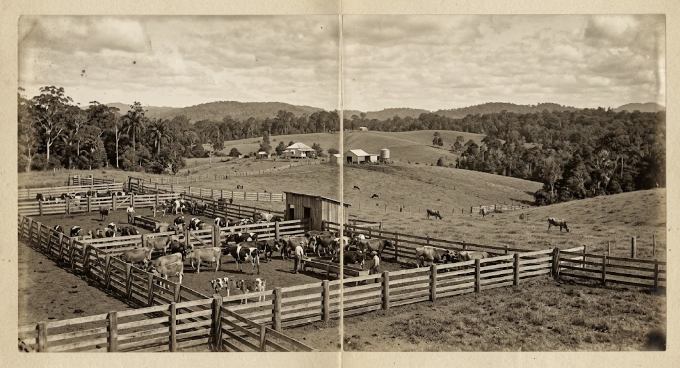
The two are genuinely different weddings. The hinterland around Maleny, Montville and Flaxton sits several hundred metres higher, which means cooler air, frequent low cloud and views that appear and disappear within the hour. The coastal strip is warmer, brighter, windier and far busier in peak season. Guests will underestimate the drive between them, particularly after dark on winding roads.
The subtropical pattern puts most rain in the warmer months, with summer storms that arrive quickly and clear quickly. Winter and the shoulder months are drier and mild, which is why they are heavily booked. Whatever the season, a wet weather plan that people have actually walked through is worth more than a forecast.
Venue pricing, availability and peak season vary year to year. Treat anything specific as something to confirm directly with the venue.
The whole thing in sequence, from the first decision to the certificate arriving in the post. Written for couples who want to understand the process once and then stop thinking about it.
Most of the anxiety around wedding legalities comes from assuming the state has opinions it does not have. It does not care about your venue, your clothes, your guest count, your religion or lack of one, your vows beyond a single sentence, or whether you rehearse. What it requires is an authorised person, timely notice, two witnesses, specific words, and signatures.
Getting this clear at the start reorders everything that follows. The legal requirements become a short checklist handled in the background, and the ceremony becomes a design problem rather than a compliance exercise.
This is counterintuitive, because couples normally book a venue first. But the celebrant is the person who receives your notice, and the notice is the only part of the process with a hard legal deadline. Good celebrants also book out earlier than most suppliers, particularly for Saturdays in the dry season.
Check the public register of marriage celebrants maintained by the Attorney-General's Department before you pay anything. Search by name or postcode; it is free. If a person cannot be found there and is not a minister of a recognised denomination or a registry officer, they cannot marry you.
Ceremonies fail in predictable ways: too long, too generic, too inward-looking, or so tightly scripted that nothing human happens. Deciding the purpose first avoids all four. Some couples want to be witnessed by their community; some want to mark a change privately with people watching; some want it over quickly so the party can start. All of these are legitimate, and they produce very different ceremonies.
Say this out loud to your celebrant at the first meeting. It is far more useful to them than a list of readings.
Capacity is the one part of this that cannot be fixed later. Both parties must be at least eighteen, with the narrow exception of a sixteen or seventeen year old marrying someone eighteen or over under a court order granted in exceptional and unusual circumstances together with parental consent. Neither party may already be lawfully married to someone else, which means a divorce has to be finalised rather than merely filed. Marriages between an ancestor and descendant, or between siblings including by adoption, are void. And consent has to be real, freely given by people who understand what they are agreeing to.
The practical failure here is almost always the divorce, where a couple assumes that separation or a filed application is enough. It is not, and the order takes as long as it takes.
You need an official birth certificate or a current passport, and if either of you has been married before, a divorce order or the death certificate of the former spouse. The celebrant must sight the evidence of a previous marriage ending before the wedding, not on the day.
The practical risk here is not the requirement but the retrieval. Replacement birth certificates from interstate registries, documents held overseas, and divorce orders from decades ago all take longer than people expect. Start this at six months, not at six weeks.
Documents that are not in English need a certified translation, which is sequential with everything else rather than parallel to it. And if your documents carry slightly different versions of the same name, which transliteration and previous marriages both produce routinely, show your celebrant everything at once so they can sort it out in one conversation.
The notice of intended marriage must reach an authorised celebrant at least one month before the ceremony and not more than eighteen months before it. Both parties sign it in front of an authorised witness, which may be the celebrant, a justice of the peace, a solicitor, a doctor or another approved person.
You cannot lodge it yourself, and there is no marriage licence in Australia, so there is no office to visit. The month runs from receipt, which is why posting a notice four weeks and two days out is a worse idea than it sounds. Four to six months before the date is comfortable and leaves room for a document problem.
The month can be shortened only by a prescribed authority on limited grounds, and leaving it late is not one of them.
A civil celebrant must state that they are authorised to solemnise marriages and remind the couple of the nature of the relationship, including that marriage in Australia is the union of two people to the exclusion of all others, voluntarily entered into for life. Each party must then say a short prescribed sentence calling on those present to witness the marriage.
That is all. Build whatever you want around it, and consider placing the legal element early so the room can relax afterwards. Ministers of religion of recognised denominations use their own rites instead, which is worth knowing if you are combining traditions.
Two witnesses aged eighteen or over must be present and will sign. Tell them in advance that they are signing a legal document, because being surprised by it in front of a crowd makes people hesitate. Readers should have their text printed in a size they can read in bright light or low light, whichever applies.
Both parties also sign a declaration of no legal impediment to marriage shortly before the ceremony. Celebrants usually handle this at the rehearsal.
Three documents are signed at the ceremony. The decorative one handed to you is commemorative and is not an identity document. The registry copy is the one that leads to your official certificate, and the celebrant keeps the third.
This single distinction causes more administrative grief than any other part of the process. Couples try to use the ceremony certificate for a passport or a visa months later and discover it is a keepsake.
The celebrant must lodge the marriage for registration with the state or territory registry within fourteen days. Once registered, you apply to that registry for the official marriage certificate. If you have a deadline, a visa application or travel booked in a married name, allow for both the fourteen days and the registry processing time, and apply as soon as you can.
Nothing in Australian law requires a name change on marriage. Where a name is changed, the official certificate is the document agencies will ask to see, and the order of operations usually runs passport, then licence, then banks and employer, because each wants to see the one before it.
This guide avoids quoting celebrant fees, registry fees, processing times and form version numbers. They differ by state and are revised, and a stale figure is worse than none. Where a number matters, take it from the Attorney-General's Department or from the registry for the state where you are marrying, and check the date you looked.
No. Australia has no marriage licence. The equivalent step is the notice of intended marriage, a form given to an authorised marriage celebrant at least one month and not more than eighteen months before the ceremony.
The term licence comes from other countries and causes real confusion, because couples go looking for an office to visit when what they actually need is a celebrant to receive their notice.
At least one month before the ceremony, and not more than eighteen months before it. Both limits matter: a notice given too late is not valid, and a notice given too early expires.
The month is calculated from when the authorised celebrant receives the completed notice, not from when you fill it in, so send it early if anything about your documents is uncertain.
No. Only an authorised marriage celebrant can receive and lodge the notice of intended marriage. That includes Commonwealth-registered civil celebrants, ministers of religion of recognised denominations, and officers of a state or territory registry.
In practice this means your first task is finding a celebrant, not finding a form.
Proof of date and place of birth, which is either an official birth certificate or a current passport. One of the two is enough, and a passport from any country is accepted.
If either of you has been married before, you also need evidence of how that marriage ended, meaning a divorce order or the death certificate of the former spouse, and the celebrant must sight it before the wedding.
Not legally, unless they are an authorised marriage celebrant. A friend can host, speak, run the whole feel of the day and be the voice everyone remembers, but the marriage is only solemnised if an authorised celebrant is present and the statutory requirements are met.
Many couples arrange exactly this split, with a short legal element and a friend carrying the rest.
Search the public register of marriage celebrants maintained by the Attorney-General's Department. It is free, searchable by name or postcode, and takes a couple of minutes.
Do it before you pay a deposit rather than after, because an unregistered person cannot make you married no matter how good the ceremony is.
Very few. A civil celebrant must say the statutory explanation of marriage, which states that they are authorised to solemnise marriages and that marriage in Australia is the union of two people to the exclusion of all others, voluntarily entered into for life.
Each party must then say a short prescribed sentence calling on those present to witness the marriage. Everything else in a civil ceremony is yours to write. Ministers of religion of recognised denominations use the rites of their religion instead.
Two, and both must be aged eighteen or over. They need to be physically present and able to understand what they are witnessing, and they sign the documents at the ceremony.
There is no requirement that they be friends, relatives or of any particular relationship to you.
No, and this catches a very large number of couples. The decorative certificate signed and handed over on the day is commemorative. It is not proof of identity and will not be accepted for a passport, a visa, a name change or a mortgage.
The official certificate is issued by the state or territory registry of births, deaths and marriages after the marriage is registered, and you apply for it separately.
The celebrant is required to lodge the paperwork with the state or territory registry within fourteen days of the ceremony. Registration is what makes the official certificate available.
If you need that certificate for a visa, a honeymoon booked in a married name or a name change, allow for the registry processing time on top of those fourteen days.
No. There is no legal requirement for anyone to change their name on marriage. Either party may adopt the other name, both may keep their own, and either may use a different name in different contexts.
Where a name is changed, the official marriage certificate is the document most agencies will ask to see.
Only in limited circumstances, and only by a prescribed authority rather than by the celebrant. It is a formal application on defined grounds, not a favour and not a routine step.
It is refused where the reason is simply that the couple left it late. Plan on the full month and treat any shortening as something that might not happen.
| Authorised celebrant | A person legally able to solemnise a marriage: a Commonwealth-registered civil celebrant, a minister of religion of a recognised denomination, or a registry officer. |
|---|---|
| Attorney-General's Department | The Commonwealth department that registers and regulates civil marriage celebrants and maintains the public register. |
| BDM | The registry of births, deaths and marriages in each state and territory, which registers marriages and issues official certificates. |
| Code of Practice | The standards of conduct that Commonwealth-registered marriage celebrants must follow, made under the marriage legislation. |
| Commemorative certificate | The decorative certificate signed at the ceremony. A keepsake, not an identity document and not accepted for official purposes. |
| Declaration of no legal impediment | A statement signed by both parties shortly before the ceremony confirming there is no lawful reason the marriage cannot proceed. |
| Marriage Act 1961 | The Commonwealth statute governing marriage in Australia, including who may solemnise a marriage and what must be said. |
| Minister of religion | A celebrant registered through a recognised denomination, who uses the rites of that religion rather than the civil form. |
| Monitum | The statement a civil celebrant must make before solemnising a marriage, explaining the nature of marriage under Australian law. |
| NOIM | Notice of intended marriage. The form given to an authorised celebrant at least one month and no more than eighteen months before the ceremony. |
| Official certificate | The marriage certificate issued by a state or territory registry after registration. The document used for name changes, passports and visas. |
| Prescribed authority | The person who may approve shortening the one month notice period, on limited grounds and by formal application. |
| Recognised denomination | A religious body recognised for the purposes of the marriage legislation, whose ministers may be registered as celebrants. |
| Registration | The lodging and recording of the marriage with the state or territory registry, which the celebrant must do within fourteen days. |
| Solemnise | To conduct a marriage in the manner the law requires, so that the parties are legally married. |
| Witness | One of the two people aged eighteen or over who must be present at the ceremony and sign the documents. |
Those two steps carry almost all of the legal risk, and both are free. Everything that follows is a matter of taste, logistics and how long you want your guests to stand in the sun.
Dated coverage of the detail that changes: fees, registry processing, form revisions and seasonal notes.
1. Before You Return: Are You Actually Ready to Bet Again? The first safeguard isn’t a tool on a betting site – it’s whether you’re genuinely…
How BetStop Self-Exclusion Works in Australia BetStop is Australia’s national self‑exclusion register for online gambling, and the exclusion period you choose locks you out of all…
Emotional Red Flags: When Betting Stops Feeling Like Fun When wagering is in a healthy place, it feels like optional entertainment. You can enjoy AFL betting,…